
Calhoun County Wanted List Status
Calhoun County has no standing most-wanted page. No verified sheriff's roster of names is online right now. That fact means less than it sounds. A wanted list is a publicity choice, not a complete warrant file. Behind the scenes, the Calhoun County Sheriff's Office works with operational court records, and many active warrants never get a public campaign or a photo. So zero names on a web list tells you nothing about how many warrants truly exist.
The sheriff may still flag one person at a time. Watch for an official social post or a dated press release naming a fugitive. Any such notice deserves a fresh look on the day you find it. Check who issued it, when, and what identifiers appear. Look for any capture or cancellation update that followed too. An old screenshot can float around long after the case closed. CCSO has promised no regular update schedule, no "Warrant Wednesday" feature, no photo grid, and no standing reward. Skip the unofficial name lists that try to fill those gaps.
Calhoun County Notice Fields
Read a dated official notice for what the agency published. Nothing more. A social post can leave fields blank, and it may never show what happened next. Write down the post date and the source before you rely on the text. A later post may report an arrest or a withdrawal. Keep that update with the original notice. What follows adapts the usual wanted list fields to the county's post by post approach.
| Field | What to verify |
|---|---|
| Post date | The date CCSO issued or last updated the specific notice. |
| Name and identifiers | Only the spelling, description, or other identity details published by CCSO. |
| Photograph | The agency-supplied image in that dated notice, not a rehosted copy or proof of guilt. |
| Warrant basis | The alleged offense or court process as worded in the notice, subject to later change. |
| Agency instructions | The current phone or tip direction displayed by the sheriff. |
| Later status | Any captured, canceled, served, or corrected update from an official source. |
A blank field is not an invitation to guess. A photo tells you nothing about where a person is right now. When identity is unclear, hand the source link or post date to law enforcement rather than spreading a guess.
Note: Official photos stay at their source, and no Calhoun County wanted or booking photograph appears in a local gallery here.
Use Calhoun Wanted Notices Safely
A wanted notice from Calhoun County works best as a tip sheet, nothing more. First confirm the sheriff issued it. Save the date. Then send anything useful straight to the agency through its published channel. Do not confront the person or try a detention yourself. Do not spread a claim as settled fact. If danger seems immediate, call 911. Let responders handle it.
- Open the official CCSO website and confirm that the notice or linked social item is genuinely agency-issued.
- Read the date and every status update. Treat a notice without a fresh status as historical until the agency confirms otherwise.
- Compare only the identifiers CCSO supplied. Do not identify someone from a photo alone or attach details from a person with a similar name.
- Report a current location, vehicle, or time-sensitive fact to law enforcement. Do not approach, follow, warn, restrain, or investigate the person.
- For a later booking, use the Calhoun County booking and roster sources; appearance there records intake or custody, not guilt.
Be careful with Crime Stoppers numbers. The sheriff's site has shown two different ones. An older indexed version displayed 850-674-TIPS, while a later header showed 850-785-TIPS. Verify the number on the live official page before you call. No local anonymity promise or reward terms were confirmed. Assume neither.
CCSO tip channelConfirm the current Crime Stoppers number at calhounsheriff.com before use.
Prior indexed display: 850-674-TIPS
Current header observed during research: 850-785-TIPS
Emergency or immediate danger: 911
Give the call taker concise facts and follow instructions. The agency, not an old repost, supplies the current tip route and any terms that apply.
Check Calhoun County Warrants
A Calhoun County warrant check means making contact. There is no search box to type into. The CCSO Warrant/Civil Process Division lists its office, clerk, phone, email, and weekday hours, and it can answer warrant questions. The Calhoun Clerk's public court search shows docket events. It cannot certify that officers still treat a warrant as active. The two sources answer different questions, so use both.
- Gather a full legal name and other known identifiers without sending sensitive personal data to an unofficial service.
- Contact the Warrant/Civil Process Division and ask what information it can confirm through its official process.
- Search the Calhoun public court-record portal for a matching criminal case and review docket dates carefully.
- Confirm identity with a case number, dates, and parties. A same or similar name does not prove the record concerns the same person.
- If a warrant may concern you, speak with a lawyer or the appropriate court or law-enforcement office about a lawful resolution.
The last step is about resolving process, not avoiding it. Counsel can explain surrender, appearance, bond, or motion procedures that fit the actual case. An online docket entry may lag, remain visible after action, or use court language that differs from the intake allegation. Ask the issuing or serving authority for current confirmation.
Calhoun Warrant Division Contact
This division is the strongest Calhoun specific path. Sheriff Michael A. Bryant's office runs no public criminal warrant portal. The office sits on the first floor of the Historic Calhoun County Courthouse, and it closes on legal holidays. A call or email can explain how the agency verifies warrants. Skip sending private identifiers by email, though, because messages to a Florida agency may become public records.
Warrant/Civil Process Division
20776 Central Avenue East
Blountstown, FL 32424-2276
850-674-5049
Monday-Friday, 8 a.m.-4 p.m. Central
Clerk: Jara Whitworth
JWhitworth@calhouncountyflsheriff.gov
The official warrant office page shows the current contact path and why direct verification replaces any web list in Calhoun County.
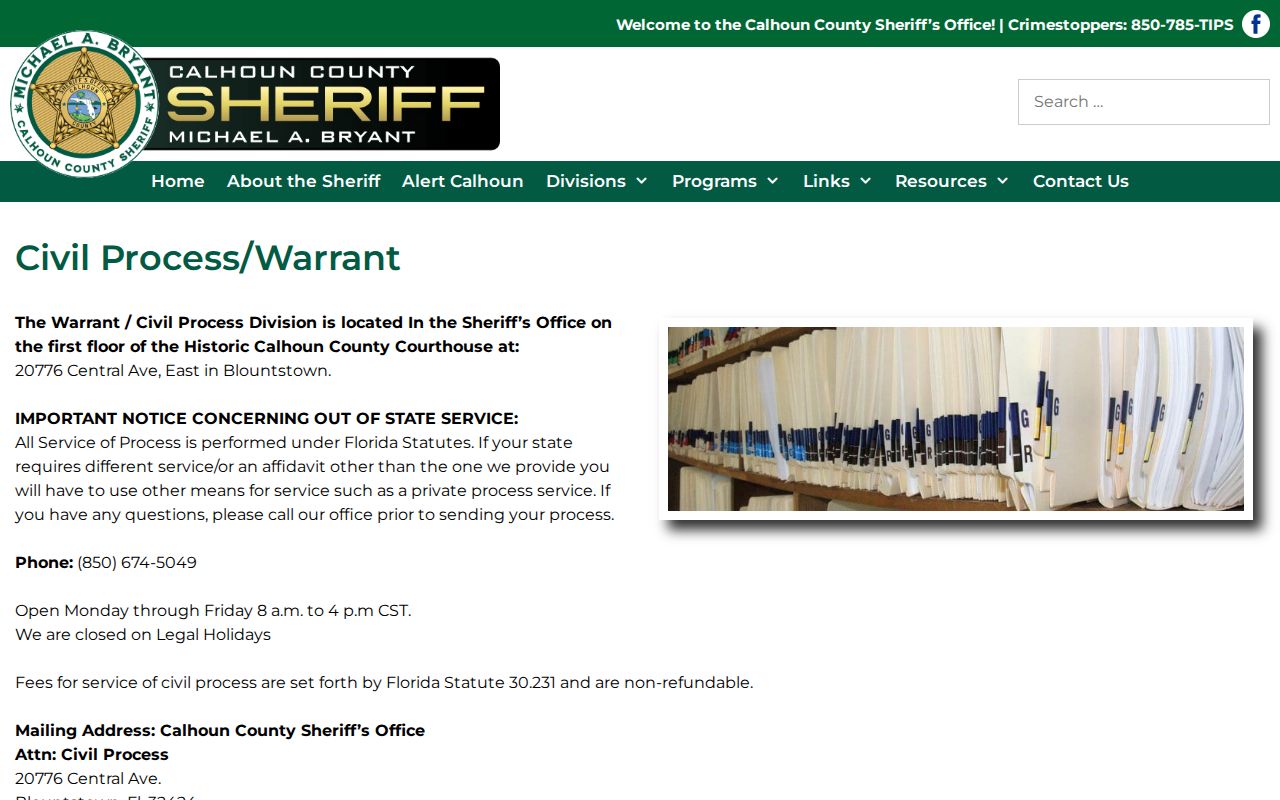
The interface is a contact page, not a results screen. No name entered elsewhere counts as confirmed just because this division also handles civil process.
Calhoun County Warrant Terms
Labels can describe very different legal steps. A short wanted notice leaves a lot out. The court file supplies that missing context. These plain-language distinctions can help you frame a question for the division or the Clerk. Still, the issuing document controls. Never assume duty, release terms, or current status from a label alone.
| Term | Practical meaning | Best verification path |
|---|---|---|
| Arrest warrant | A judicial command authorizing an arrest based on the matter described in the warrant. | CCSO division for current enforcement status; Clerk docket for public case events. |
| Bench warrant | A warrant issued by a court, often tied to a missed appearance or failure to follow a court order. | Clerk case docket, then the court or serving agency for current status. |
| Capias | A court-issued command that may direct custody or appearance; the docket and document define its effect. | Clerk and issuing court, with CCSO confirmation when enforcement status matters. |
| Dated wanted notice | A public request for information about a selected person, not a complete warrant index. | Original CCSO notice plus any later official update. |
A docket entry can be tricky to read. It may show that a warrant was issued. Yet it can say nothing about service, recall, or follow-up by an agency. Flip it around. A blank public docket still doesn't mean nothing exists. General users also run into limits from confidentiality rules, spelling errors, timing gaps, and case type restrictions.
Note: The Clerk's file records court activity, but only the proper authority can confirm a warrant's current operational status.
Calhoun Alerts Are Not Warrants
No verified CCSO-branded inmate-search app exists for Calhoun County. Some official mobile-capable channels are out there, though. None takes the place of the Warrant/Civil Process Division. Alert Calhoun runs on Everbridge and handles emergency and community notices. Florida VINE reports custody status and change alerts online, by phone, or through an app. The Clerk's E-Notify sends reminders for eligible court events once a case exists. A Kologik web roster lists who is currently in county custody.
Every tool starts from a different spot. An alert subscription won't hand you a full wanted list. VINE can tell you custody changed. Yet it won't decide the charge or reveal a final disposition. E-Notify follows case events, not arrests. The Florida Department of Corrections search only covers sentenced state offenders. The roster may show a later booking. But someone released from the Calhoun County Jail can vanish from view, because public history mode is off. Match the tool to the question. You'll avoid false conclusions.
Resolve Calhoun Warrants Lawfully
The court file is where the real story unfolds. Filed counts, hearings, orders, pleas, adjudication, dismissal, sentence, and closure all appear there in time. First appearance is just an early hearing. It is not the finish line.
Think a warrant might involve you? Call a lawyer, the court, or the law-enforcement agency involved. That route builds a safe, planned response around the actual case. A stale social post or an unofficial database can't do that. Friends and family should never hide someone, destroy evidence, or interfere with an arrest. Passing along counsel details and verified agency contacts is the right way to help.
When you call in a tip, stick to what you actually saw, where, and when. Skip the embellishment and the private details. Worried about a warrant of your own? Use the division, the Clerk, the court, and a lawyer. Those routes keep the record accurate and help a matter close lawfully instead of haunting someone forever.